
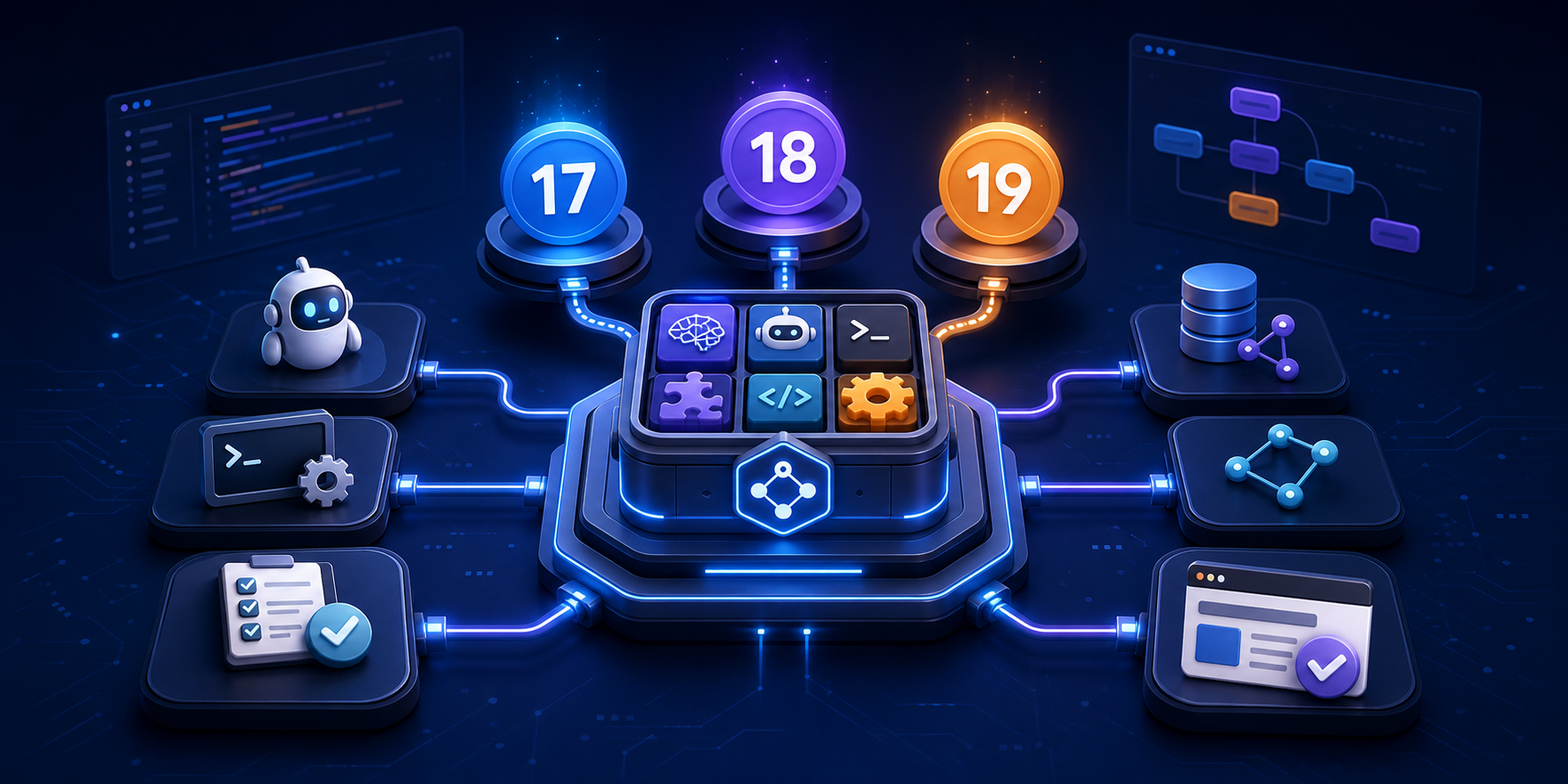
Odoo custom development becomes difficult to scale when every developer or AI coding agent must rediscover the same version rules, setup commands, testing practices, and deployment steps. The open-source Odoo Agent Pro Kit turns that repeated work into a reusable, version-aware development system for Odoo 17, 18, and 19.
The complete project is free and public under the Apache License 2.0. You can inspect, clone, fork, and contribute to it directly on GitHub: infovpcs/odoo-agent-pro-kit.
What problem does the Pro Kit solve?
AI coding tools can write Python, XML, JavaScript, and tests, but a useful Odoo development agent needs more than code generation. It must understand the active Odoo version, existing model and view dependencies, security conventions, module installation and upgrade procedures, backend and frontend testing, browser validation, and the project’s current state.
The Pro Kit packages those expectations as reusable skills, commands, hooks, context templates, local setup tools, and a live Odoo MCP server. The result is a consistent lifecycle that an experienced Odoo developer can guide and review instead of repeatedly rebuilding the surrounding workflow.
Odoo 17, 18, and 19 compatibility
The repository deliberately supports Odoo 17.0, 18.0, and 19.0. Its coding-standard, dependency-context, development-tool, testing, and restart/upgrade guidance is separated by version where behavior differs. This reduces a common source of regression: applying a pattern remembered from one Odoo release to another without checking whether the API, view architecture, or framework convention changed.
- Odoo 17: version-specific coding standards, tools, dependency discovery, testing, and module lifecycle guidance.
- Odoo 18: dedicated rules plus transitional patterns for teams moving toward Odoo 19.
- Odoo 19: current patterns for models, views, security, routes, mail/HTML, tests, performance, installation, and upgrades.
A complete development lifecycle, not just prompts
The core workflow is designed around four reusable commands:
- /plan-analysis converts business requirements into structured requirements, design decisions, and implementation tasks while mapping the request to existing Odoo functionality.
- /start-coding executes the approved task loop with version-aware backend and frontend standards, dependency context, module updates, and validation.
- /testing checks the installed result through backend tests, frontend/browser flows, screenshots, and documentation evidence.
- /fleet supports coordinated work across a larger task set when multiple focused workstreams are useful.
This structure keeps requirements, implementation, and verification connected. It also gives the human developer clear review points instead of treating a long chat transcript as the only source of truth.
What is included?
- 21 validated skills: coding standards, live dependency context, development tools, backend and frontend testing, module installation/update, restart/upgrade rules, browser automation, documentation, PRD writing, and diagramming.
- Live Odoo MCP server: XML-RPC/JSON-RPC-backed discovery of real models and environment context for Odoo 17, 18, and 19.
- Lifecycle hooks: SessionStart, PreCompact, and Stop hooks help initialize the right environment, preserve progress during context compaction, and clean up services.
- Local workspace automation: bootstrap and module-management scripts help create repeatable Odoo workspaces instead of relying on machine-specific manual steps.
- Agent context templates: ready-to-adapt instructions for Claude Code, Codex, Cursor, Antigravity, VS Code Copilot Chat, and GitHub Copilot CLI/Agent.
- Open-source project scaffolding: CI validation, contribution guidance, issue and pull-request templates, code of conduct, and an Apache 2.0 license.
New in this release: Docker Sandbox for isolated, concurrent sessions
The latest update adds a complete Docker Sandbox execution layer (Phases 0–7) so every planning, coding, and testing session can run in its own isolated agent workspace instead of competing for one shared local Odoo install. One task now maps to one Docker Sandbox microVM running a private Compose stack with the pinned Odoo 17, 18, or 19 image and PostgreSQL 15 — its own Git branch, database, filestore, logs, MCP context, and test results.

- sandboxctl module is the single install/update/test entrypoint inside every session. It delegates to
manage_modules.sh, so local and sandboxed execution share the exact same contract. - Explicit-only exposure: sandboxes never mount the host Docker socket and never publish a port by default — only an explicit loopback publish opens Odoo HTTP, MCP, or debug access.
- Recovery and quarantine: a failed restore, crash, or interrupted operation quarantines the session instead of leaving it in an inconsistent state, with redacted diagnostics bundles for troubleshooting.
- Bounded, measured concurrency: Community's /fleet keeps sessions on one host through
sandbox-fleetcapacity and locking. Limits come from live measurement, not assumption — the documented Phase 7 test on a 2 vCPU/15 GiB host reached a warm Odoo 19 session in 42 seconds, and correctly rejected six simultaneous cold provisions as exceeding safe host capacity. - Explicit, reversible migration:
migrate-local.pymoves an existing clean local module workspace into a sandbox session, excluding.git, secrets, and environment files — never silently and never irreversibly. - Same skills, every tool: Claude Code, Codex, Cursor, Antigravity, VS Code, and GitHub Copilot all reach a session through the same thin
sandboxctl exec/SSH adapters, so the Odoo skills, commands, and MCP context stay identical regardless of which coding agent is driving.
Docker Sandbox is validated on Ubuntu 24.04 KVM hosts today; Apple Silicon and Windows procedures are open community platform validation candidates — contributors with that hardware can run the documented LIVE TEST procedure and submit evidence or fixes by pull request. Community stays free and Apache-2.0; shared/remote fleet scheduling, upgrade-factory tooling, and managed hosting are being planned as a separate Pro layer that consumes tagged Community releases rather than forking this repository.
August 2026 update: release 0.4.0 closes the Phase 8 exit gate
Odoo Agent Pro Kit 0.4.0 moves the project beyond framework scaffolding and sandbox infrastructure into evidence-backed client readiness. The current repository validation covers 21 skills, while the native Hermes plugin registers 20 bundled skills through its own adapter.
The Phase 8 release candidate was exercised through two real Tier-1 Odoo 17-to-18 migrations: edit_remove_pricelist_rule and hr_document_report. The validation included eight and six backend tests respectively, browser-level workflow checks, PDF output evidence, and XSS-safety checks. Both migrations also proved the Enterprise-dependency detection path without downloading or redistributing licensed Enterprise source code.
- Database-backed install verification: release 0.3.3 fixed a subtle automation risk where an Odoo command could exit successfully after silently skipping a module. The workflow now verifies the actual installed or upgraded module state in the database.
- Five orchestration checks: planning, implementation, module lifecycle, backend validation, and browser/evidence handling were exercised as one governed workflow.
- Migration proof: two distinct modules reached Odoo 18 with version-aware code changes and repeatable tests rather than documentation-only compatibility claims.
- Release decision: the Phase 8 gate is marked MET, with a GO recommendation for phased, staggered adoption so teams can expand usage while preserving human review and rollback discipline.
The updated architecture documentation connects the supported AI clients, reusable skills, Odoo MCP context, Docker Sandbox execution plane, and validation evidence into one operating model. See the latest public repository for the current release and evidence.
Practical demonstration: building a real Odoo 19 module
The long-form video Master Telegram Integration in Odoo 19 Enterprise | Automated Development & Live Sync Benefits demonstrates the development model in practice. It is not a dedicated Pro Kit installation tutorial; it uses a Telegram integration as the real custom-application example.
Across the demonstration, the agent loads reusable Odoo skills, studies dependencies, prepares a plan, implements the module, uses live database and log context, runs tests, performs browser-level validation, fixes issues found during execution, and carries context forward through the development cycle. That is precisely the kind of repeatable workflow the public Pro Kit makes easier to adopt.
The value is not that an agent can generate one module. The value is that the team can reuse a governed development system for the next module—and the next Odoo version.
Quick start
git clone https://github.com/infovpcs/odoo-agent-pro-kit.git
cd odoo-agent-pro-kit
./bootstrap.sh --versions 19
For a multi-version environment, pass the required versions to the bootstrap script. The repository’s Quickstart section is the best starting point.
Claude Code plugin
/plugin marketplace add infovpcs/odoo-agent-pro-kit
/plugin install odoo-agent-pro-kit
Codex, Cursor, Antigravity, VS Code, and GitHub Copilot
Each supported tool has its own installation guidance in the repository’s integrations directory. Codex can start by copying the supplied context-templates/AGENTS.md into the target project root; the other adapters provide equivalent tool-native instructions.
Where the kit helps most
- New custom modules: turn a business request into a reviewable PRD, scoped tasks, implementation, tests, and documentation.
- Existing Odoo environments: inspect installed modules, inherited models, dependency trees, and views before making changes.
- Version migration: keep Odoo 17, 18, and 19 rules distinct while replacing deprecated patterns and validating module upgrades.
- Team consistency: give developers and different AI tools the same project constraints, safety rules, and definition of done.
- Testing and evidence: combine backend verification with browser testing, screenshots, and technical/user documentation.
Human review remains essential
The Pro Kit is an engineering accelerator, not permission to deploy unreviewed generated code. Production Odoo work still requires business validation, access-control review, backup and rollback planning, migration checks, performance awareness, and human approval for consequential changes. The toolkit’s purpose is to make those expectations explicit and repeatable.
Explore, contribute, or get implementation help
Start with the public Odoo Agent Pro Kit repository, review the contribution guide, and watch the full Odoo 19 agentic-development demonstration.
For cloud infrastructure and Odoo hosting, visit VPCSCloud. For Odoo consulting, implementation, customization, migration, and AI automation services, visit VPerfectCS.